


This classic Persian rice recipe (chelo) features fragrant basmati rice, golden saffron, and a crispy potato tahdig. A must-have side dish in Persian cooking, it’s both simple and stunning. Find more of my Persian recipes.

Reader’s Reviews
“Absolutely loved this rice! It makes a part of meals that is often plain and boring into the star of the show! Will make again 🙂” — Jessie
What is comfort food for your family? For many this could be soup or a stew. The word “comfort” brings images of a warm hug, or a blanket to wrap yourself up in as the months start to cool.
In our house, our go-to comfort food is Persian saffron rice.
Rice is the foundation food in most of our Persian dishes. From Persian kabob to Persian stews (khoresh), like ghormeh sabzi, we always serve it with this aromatic long grain rice.
Unlike other cultures, we Persians love to make a crunchy crust on the bottom of the pot of rice, the tahdig. Sometimes it is rice, but in this recipe I use slices of potato.
Jump to:
Laura’s tips
Why this recipe works
- Tahdig: That golden, crispy crust at the bottom of the pot is everything! Whether it’s potato, lavash, onion slices, or even tortillas, tahdig is the crown jewel of Persian rice.
- Tried and True Method: Sure, rice cookers are convenient, but they can’t do tahdig justice. I learned this stovetop method in college from my engineer uncle, and after 30+ years of practice, I’ve broken it down into easy, foolproof steps.
- Perfect Texture: Persian rice is all about the long, fragrant grains of white basmati. Washed and parboiled, then steamed to fluffy perfection – never sticky, always light.
- Amazing Flavor: Persian chelo may seem boring, but it’s full of aroma and character. Top it with a little saffron rice, and it’s pure magic on the plate.
- Pairs With Everything: From kebabs to stews to grilled veggies, Persian basmati rice is the ultimate base for just about any meal.


Ingredients you need

This post contains some affiliate links for your convenience (which means if you make a purchase after clicking a link I will earn a small commission but it won’t cost you a penny more)! Read my full disclosure policy
- Basmati rice: Remember to choose a high quality basmati rice. Many of the varieties you find at the grocery store have less flavor and are processed so they cook faster. You want long grain basmati rice, preferably Indian. Several brands I like are Royal, Pari and Zaffaroni basmati rice
- Salt: Don’t skimp on the salt! It really brings out the flavor of the rice without making it super salty. I use sea salt in these measurements.
- Saffron: When using saffron, choose long strands that are crimson in color for best quality. Learn how to buy, use, and store saffron.
- Extra virgin olive oil: Even though we use a non-stick pot to make our rice, you need some oil to make the tahdig crispy and crunchy. You can use regular canola oil and even butter. I prefer olive oil.
- Potato: Slices of potato are place on the bottom of the pot to make the potato tahdig. I prefer to use the russet potato because the slices are large and one potato lines a pot easily. You can use any potato you have on hand. Other tahdig options include pieces of lavash or slices of tortilla. We also make a delicious tahdig using slices of onions.
- Coriander seeds: This is totally optional. Some of my family add a little coriander seeds with the potato slices for the tahdig. The seeds get toasted and are very aromatic.
How to bloom saffron

Saffron is used to make that yellow rice we all know and love in Persian chelo and even in Spanish paella. The best way to use saffron is to keep it in its thread form.
- Crush the saffron. Place the saffron threads in a mortar and pestle and crush it until it is powdered.
- Add hot water. Add a tablespoon or two of hot water and let the saffron bloom or steep at least 10-20 minutes. The longer it sits, the deeper the color.
This bloomed saffron water is a bowl of bright orange water. But don’t let that color fool you either! Because when you mix that golden orange water with rice, you end up with some beautiful yellow rice. And that smell, it’s swoon worthy!
Step-by-step directions
Preparing traditional Persian rice is very different from how you prepare most other rices. Basmati rice does have starch in it, and Persians like to remove some of that starch before cooking it so it is less sticky.
To make chelo, Persian basmati rice, the traditional way you have to clean it, wash it, parboil it, strain it and then steam it. I was very intimidated when I first made this basmati rice recipe, as well as any other Persian dishes, as I was a novice. I thought it was complicated.
But the more I made it, the more I learned from my mistakes. And I have broken it down very simply in my recipe directions and video.
Want to save this recipe?

- Clean and soak the rice. In some parts of the world you have to remove the pebbles and debris in the rice. Here in the US, this is not necessary. But we rinse the rice to remove the starch. I usually rinse the rice and drain it three times.
I find that a longer soak helps reduce the starchiness and stickiness, giving me fluffier rice with separate grains. Some people soak the rice overnight. I only soak it after rinsing it and let it sit while I boil my pot of water.
- Parboil the rice. Bring a large pot of salted water to boil. Drain your rice and then add it to the boiling water. Boil it for 6 minutes, or until the outer part of the rice is cooked but the inside is still hard. I live at sea level and 6 minutes is the time it takes for my rice to reach this state.
- Strain the rice. You do not want to completely cook or over cook the rice. When it is mostly cooked but still hard inside, pour the contents of the pot in a fine mesh strainer to drain out the water.
- Prepare the potato tahdig. Return the pot to the stove, turn heat on to medium and coat the bottom of the pot with oil. Add the slices of potatoes in any pattern you like. If using the coriander seeds, add those first and place the potatoes on top. Season the potatoes with salt.
- Assemble the rice. Using a spatula, layer the strained rice back into the pot. You want to scatter the rice in. Break up any clumps of rice. Do not press the rice into the pot or this will create mushy rice.

- Add remaining rice. Scatter the layers of rice in the center of the pot, forming a bit of a pyramid. Using the handle of a wooden spoon or other utensil, gently press it thru the rice to create a steam vent.
- Steam the rice. Cover the lid of the pot with a thin towel or two layers of paper towel and gently press it over the pot. The towel will collect the excess steam and keep your rice from getting mushy. Cook over medium heat for 7 minutes, then reduce the heat to low and steam for about 45 minutes, until the rice is fluffy and the potato tahdig is golden and crisp.
- Bloom the saffron. I mentioned above the two different ways you can use the saffron you steep. I typically grab a bit of hot water boiling in the pot before I add the rice and use that to steep the ground saffron.
For saffron rice mixed throughout: Pour the saffron water over the rice now.
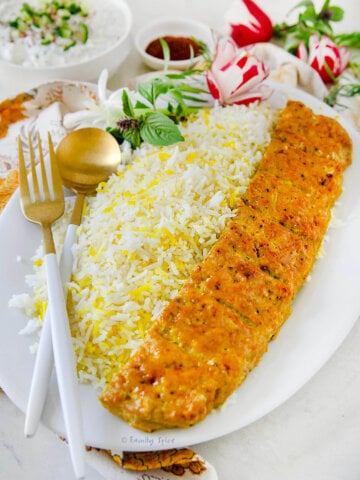
For a yellow saffron rice topping: Reserve the saffron water until serving. When the rice is cooked, scoop about 1 cup of rice into a bowl, mix it with the saffron water, then spoon the yellow rice over the white rice on your serving platter.
- Serving option 1: To serve the rice as a cake, place a large platter over the pot, leaving plenty of room around the edges. Holding the pot and platter firmly, carefully invert them together. Set the platter down and gently lift the pot. This method is pictured above.
- Serving option 2: I prefer to serve my rice this second way. Gently scoop the rice onto a serving platter with a spatula. You’ll find the crispy potato crust (called tahdig) at the bottom of the pot. Arrange the pieces around or on top of the rice.

Expert tips and recipe FAQs
If your tahdig is not crispy enough, do not fret. You can leave it in the pot and heat it on high for a few more minutes to crisp it up. If your tahdig is stuck to the pot, fill the kitchen sink with an inch or two of water and place the bottom of the pot in this water.
After a few minutes, the pot will cool and the tahdig is easier to remove. I find that a thin spatula helps slide under the tahdig much more easily than a thicker one.
Family wars are fought over these crispy and crunchy bits of deliciousness, so I highly recommend you trying it! And if you ever go to a Persian restaurant, you can be served crunchy tahdig topped with Persian stews, like khoresh bademjan, fesenjoon or khoresh gheymeh.
If you are looking for your a way to use your leftover rice, try my sausage fried rice recipe using whatever protein you have on hand. Even though fried rice is traditionally made with short grain rice, I make it all the time with leftover Persian rice.
Storing/Freezing Instructions
TO STORE: Cool the rice promptly, then refrigerate it in an airtight container within two hours. Use within 3–4 days.
TO FREEZE: Freeze cooled rice in an airtight, freezer-safe container for up to 3 months. The texture may be less fluffy after thawing and reheating.
My mom likes to soak the rice overnight or for many hours before parboiling. Me? Not so much. You can parboil the rice and store the drained rice in an airtight container in the fridge up to one day before steaming. Just be sure to rinse the rice in a colander before layering it in the pot for the final steam. A third way to prepare Persian chelo ahead of time, is to assemble everything in the pot for the final steam an hour or two before cooking in the fridge. Just sprinkle in some water to rehydrate the rice before steaming.
Tahdig is the crispy crust formed in the bottom of the pot when making Persian rice. Tahdig comes in many forms, from crispy rice to potato slices. You can also add slices of lavash bread, tortillas and even onion slices to make tahdig.

Persian Rice with Saffron and Potato Tahdig
Ingredients
- 3 cup basmati rice
- 8 cup water for boiling
- Additional water for washing and soaking the rice
- 2 tablespoon salt divided
- 1 tablespoon hot water
- ½ teaspoon crushed saffron
- 2 ½ tablespoon extra virgin olive oil
- 1 russet potato cut into ¼-inch thick circles
- 1 teaspoon coriander seeds optional

Instructions
- Cover the rice with water and gently wash the rice by stirring it with your hand. This helps release the starch. Pour out the water and repeat two more times.
- After washing the rice a third time, rinse and then cover rice with water and add 1 tablespoon salt. Let it soak for up to 4 hours. I find that a longer soak helps reduce the starchiness and stickiness, giving me fluffier rice with separate grains.
- In a 5-quart non-stick pot add 8 cups of water and the remaining 1 tablespoon salt and bring to boil.
- When the water has come to boil, pour out the water in the bowl containing the soaking rice. Add the wet rice to the boiling water.
- When the water comes to boil again and the rice floats to the top of the pot (approximately 6 minutes), pour the contents of the pot into a fine colander. You know your rice is ready to strain if you bite a rice kernel and the center is still uncooked.
- Return the pot to the burner, set heat to medium and add 1 ½ tablespoon oil.
- If using coriander seeds, sprinkle them on the bottom of the pot, and arrange potato slices over them.
- Using a spatula, gently scoop the drained rice into the pot. Make sure you do not push the rice in together as this will result in mushy rice. Scatter the rice throughout the pot, in a pyramid shape until finished. Your pot should not be filled to the top. You will need about 3 inches between the top of your rice and the top of the pot. If you must tap the rice off of your spatula, do not tap it against the pot. This will move the rice in the pot and press them together. Tap your spatula against the colander.
- Using the handle of a long wooden spoon or another utensil, gently press several holes around the rice down to the potato crust. This will allow the steam to travel freely through the pot.
- Drizzle the remaining 1 tablespoon of oil over the rice. If you prefer butter, cut 1-2 tablespoon into small pieces and dot them over the rice.
- For saffron rice mixed throughout: Pour the saffron water over the rice now.For a yellow saffron rice topping: Reserve the saffron water until serving. When the rice is cooked, scoop about 1 cup of rice into a bowl, mix it with the saffron water, then spoon the yellow rice over the white rice on your serving platter.
- Cover the pot with a clean kitchen towel or several paper towels, then place the lid firmly on top to trap the steam. Cook over medium heat for 7 minutes, then reduce the heat to low and steam for about 45 minutes, until the rice is fluffy and the potato tahdig is golden and crisp.
Notes
Nutrition
Nutrition Disclaimer
Nutritional information is an estimate provided to you as a courtesy. You should calculate the actual nutritional information with the products and brands you are using with your preferred nutritional calculator.
PS If you try this recipe, why not leave a star rating in the recipe card right below and/or a review in the comment section further down the page? I always appreciate your feedback.
You can also follow me on Pinterest, Facebook or Instagram. Sign up for my eMail list, too!
Written by Laura Bashar
Hi, I’m Laura, a certified professional cook and cookbook author living in San Diego. I have been sharing my family’s favorite recipes inspired from all over the world since 2008. Let’s cook up something fun!
This post was originally published October 14, 2012. It has been updated with more content, new photos and videos.

My grandfather is from Iran, but is Assyrian, so my comfort food is Assyrian style rice. The recipe is similar with the washing and parboiling, but the rice goes into a dutch oven with butter for a day of slow cooking. While I LOVE Assyrian style rice, I am looking forward to trying your recipe. Oh and when I say ‘rice’ I mean Basmati (is there another kind? 🙂
Have you tried Armenian rice? We went to an Armenian restaurant and they add allspice and some of these little noodles in their version. We are basmati lovers all the way!
What a great tutorial! I adore saffron rice, especially in a Paella. I bought a small tin of saffron a year ago for some saffron-cheddar scones and have yet to use the rest of it, like you said it’s so expensive I feel I should put it on a shrine in my kitchen 😉
This is AMAZING! I was absolutely mesmerized from start to finish. And your cousin’s music is incredible. As an avid Family Spice reader, I hereby request MORE VIDEOS!!!
Laura, this video is absolutely beautiful! I LOVE your cousin’s music! The preparation of the rice was like watching a ballet — so graceful, so artistic, with such a great rhythm. And needless to say, the dish looks so delicious — especially the potato crust! Really wonderful.
I watched the video mesmerized! I can see how this dish represents the home hearth – totally comfort food:) Now I have to go buy some saffron to make Persian basmati rice one of these days:)
Thank you, Laura!
I hired an Iranian refugee in Knoxville years ago and we became great friends. She had no way to thank me for what I did for her so she cooked her traditional favorites for me. I just loved it all.
I really want to make this dish! Interesting how you prepare the rice. 🙂
I think you did a great job on the video! I absolutely need to make this Persian rice. I’m used to the spanish meals containing saffron so I have a deep appreciation for the spice, but it’s interesting to see other ways of infusing it into your food.
Basmati rice is my favourite rice. I keep trying to eat brown rice for the health benefits but it takes ages to cook and is a bit too nutty for my liking. I will watch your video tonight after work. My boss might not appreciate me advertising that I am reading food blogs.
Great video! Sophisticated technique…I want this now!
Love the video 🙂 ! Now, since I still have a small amount of the saffron I won on your blog left: guess where that is going to go? And I’m truly looking forward to it!
Basmati rice is so delicious, I love the saffron here!
This is one beautiful dish, and the video was so helpful. I can’t wait to try it. Pinned.
Isn’t it funny how we associate comfort food with cooler weather? Does anyone have a comfort food they eat in the summer? Your basmati sounds wonderfully aromatic. I can smell it from here!
Oh what a great video, and recipe. Rice is one of my favorites.
So pretty! Great recipe, great video. I love saffron but don’t use it that much (it’s partially the cost issue, I guess). But I need to make this! Really good stuff – thanks.
Cool video!! Great result –
Loved the video, Laura and your recipe sounds amazing!
That video was fascinating! And I love the guitar! All of it was beautiful. Thank you so much for sharing!
I have been looking for more saffron recipes. This one would be great for my husband because he also prefers white (basmati) rice over brown rice or grains like quinoa.
The word Persian sounds comforting with the idea of spices or dried fruits. And rice, I too think it is comfort food. I love this recipe with saffron! My brother introduced me to Persian food in Wash DC, and to this day I remember a stew with pomegranates.